EN
EN


Brand Consistency: The Strategic Importance of Consistent Advertising Displays
The Power of Consistent Brand Messaging
Brands that display consistency across all advertising formats tangibly earn the ability to be recognized faster, leading to accelerated decision-making time from customers. Consistency in advertising displays, including permanent and changeable message signs, in conjunction with display advertising and digital advertising, encourages customers to make quicker decisions, based on proven psychological theory. The more mental effort they need to recall the brand, the less likely they are to make a purchase. Disjointed signage and displays frustrate customers to the point where they reduce the perception of the quality of the products. Customers demonstrated this psychologically and resultantly in a recent study. In a study of over 700 United States customers, 72% of customers indicated a higher level of trust to brands with clean and consistent branding over those with inconsistent branding. Our brains prefer consistency and mirror this psychologically. Predictable structures reduce the amount of mental effort. This mostly translates to customers not spending the mental effort to ascertain if the brand structure is the same. The mental effort then translates to purchasing effort.
McKinsey Data: Advertising Display System Displays Cohesion = 23% Higher Customer Retention
Franchise owners implementing cohesive advertising display systems beneficially manage their costs. According to McKinsey analytics, franchise owners using cohesive advertising display systems have reported a 23 percent increase in customer retention. Why does this work? Uniformity leads to strong brand perception. Though customers have expectations based on prior experiences, their expectations create a consistent, positive experience. Banks have observed a 31% declines in complaints due to digital displays, leading to improved customer perception. The data speaks for itself.
Retention = Consistency
Consumer confidence suffers the longer a retailer loses message cohesion. One of the leading retail chains in the United States, after regional variations of displays and advertisements were eliminated, reported an 18% increase in repeat purchases. This value demonstrates the importance of consistency in advertising and messaging in building customer loyalty.
Operational Efficiency: Unified Control Over Advertising Displays
Franchise networks can become more flexible with Unified Control Over Advertising Displays. This innovative approach allows headquarters to stay updated on promotional changes system wide without the need for regular localized adjustments.

Location Updates: Deployment Time Reduced from Days to Seconds
Delays posed by outdated methods of marketing like mailing USB sticks, or massive email attachments can reach several days. This system allows for instantaneous updates by marketing teams to screens across the nation. Displays can be updated with new promotions, pricing, or holiday deals quickly so that competing stores do not surpass them. Time-sensitive advertising can be an expensive loss for stores if the information displayed is outdated.
Automated Governance Rules Ensuring Compliance with Branding Standards
Enforcement of brand guidelines ensures visual consistency across franchises. Automated governance on advertising display platforms streamlines the following checks:
- Accuracy of logo placement and sizing
- The use of approved colors and fonts
- Presence of regulatory disclaimers and expiration dates
Content that does not comply is blocked prior to publication—removing the need for proofreading. Corporate can access audit trails demonstrating 100% compliance across all locations and reducing rebranding costs by 30% (Retail Compliance Study 2023).
Performance Accountability: Measuring ROI with Smart Advertising Displays
Smart advertising displays have transformed franchise networks’ approach to marketing cost. With display systems integrated across all locations, advertising performance can be analyzed real-time, across all displayed advertisements. Therefore, franchise owners focus on ads responsible for sales increases and identify ads that require improvement. Metrics such as incremental revenue, conversion rate, and customer dwell time during ads, provide actionable insights to franchise owners. Informed by these metrics, owners can increase their advertising budgets on successful ads, and decrease their budgets on less successful ads. The single biggest advantage of having standardized advertising displays and having measured marketing performance across their franchise networks, is that they can evaluate their marketing performance dashboard and assess if their advertising costs are effective, or not.
Financial KPIs, Engagement KPIs, and Conversion KPIs have a positive impact on marketing effectiveness. The Financial KPI is Incremental Revenue, which measures sales increase during periods of display advertising. Engagement KPIs are measured by Dwell Time, which measures customer focus and interest. Conversion KPIs are measured by the Action Completion Rate, which measures the effectiveness of customer conversion.
By measuring the effectiveness of advertising through financial KPIs, engagement KPIs, and conversion KPIs, franchises improve their marketing effectiveness by 18-27%, just by measuring their marketing effectiveness through smart advertising displays.
Scalable Customer Experience: Coordinating Advertising Display to Increase Conversion
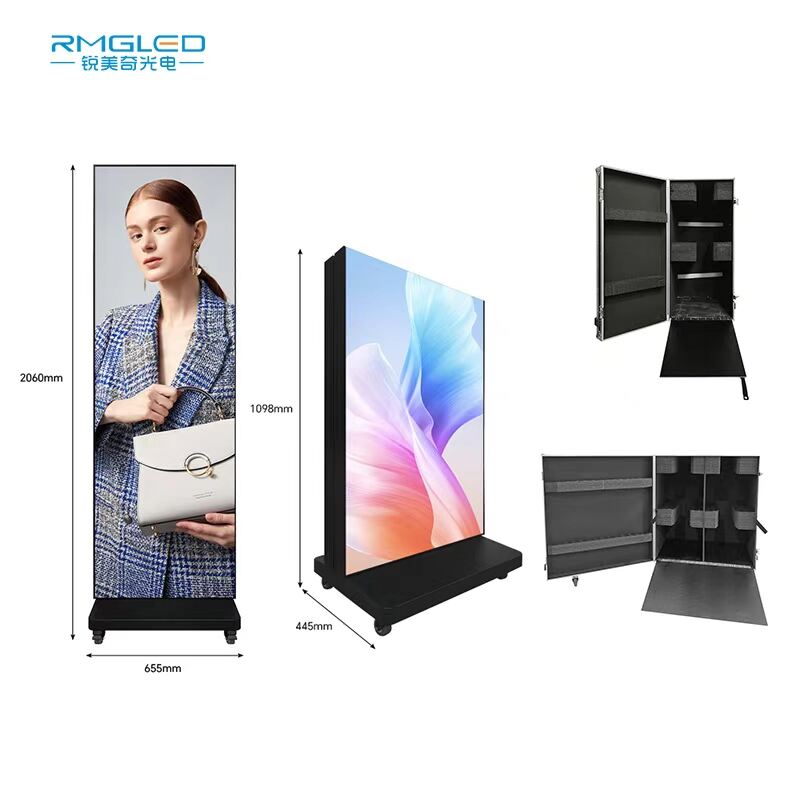
From In-Store Experience to Purchase: How Integrated Advertising Display Increases Conversion by 12–19%
When advertisements collaborate at various locations, they give purpose to consumers' random encounters, guiding them from the initial product awareness to the final purchase decision. Uniformity from different locations is beneficial for brands and eliminates customer confusion. Imagine entering a retail store in New York and then another in Los Angeles. If the signage and displays are the same, shoppers know what to anticipate. Studies show that retailers with a consistent visual style achieve a sales increase of 12% to almost 20% because their communication is clear and customers don’t feel pressured to make a decision. The brain simply operates more efficiently when everything is cohesive.
Here, we get to see the full effect of personalization at play. Digital displays that alter their content based on real-time external factors, such as pedestrian traffic, and even the current weather, create much more pertinent messaging. If you’ve seen a digital sign that switches to iced coffee ads on hot days and then changes to hot coffee ads when the temperature drops, then you can understand how even small changes can influence people’s perception of the offer. There are plenty of other interactive elements at play, such as QR codes and touchscreens that offer shoppers the opportunity to engage with the advertisements to learn more about the products without having to leave the display. This level of engagement transforms someone who may have only been passing by to take a closer look at the display, and most importantly, it increases the likelihood that they will make a purchase.
The data conclusion is performance tracking. A few examples of performance tracking are:
- Duration of engagement measured by sensors
- A/B testing to measure effectiveness of content
- Sales measurement by correlating views to displays and POS data.
This data is received in a loop and because of this, rapid optimization is achievable. Campaigns that are performing poorly are optimized in hours, rather than weeks. This means that displays are not only decorative, but are able to drive revenue.
FAQ
What is brand consistency in advertising displays?
Brand consistency in advertising displays is when the advertising displays use the same visual elements such as colors, fonts, and the positioning of the logos in order to improve brand awareness and to improve trust from customers.
How does centralized advertising display management improve operational efficiency?
With centralized advertising display management, content can be updated in real time, brand compliance can be automated, and there can be reduced time and cost. This all contributes to operational efficiency when there is consistency in content across all locations.
What are the performance metrics of standardized advertising displays?
Incremental revenue, dwell time and rate of action completion are all performance metrics of standardized advertising displays. These metrics can be used to determine how well the advertising displays are working from a franchise owner's point of view.
Why is visual uniformity important for customer experience?
Visual uniformity is important for customer experience because it minimizes cognitive overload, increases trust, and increases consistency in communication. This leads to a higher customer conversion rate.