 EN
EN

Why Do Outdoor Advertising Projects Prioritize Outdoor LED Screens?
A national retail chain in the United States launched a highway billboard campaign along Interstate 10 in Arizona using printed vinyl banners on twelve locations. Within eight weeks, the printed colors on south-facing billboards — exposed to 10-12 hours of direct desert sunlight daily — had faded visibly; after twelve weeks, the banners' cyan and magenta pigments were so degraded that the brand's signature red logo appeared washed-out orange. The campaign cost 120,000 in printing, installation, and monthly site rental. Estimated effective impressions after week nine — when the fading became obvious to passing drivers — fell below 40% of the planned reach. The following year, the same twelve locations were converted to high-brightness **outdoor LED screens**. Digital content refreshed automatically via 4G connectivity. The screens delivered identical visual quality at noon on July 15th as at midnight on January 3rd. The annual content production cost dropped to 18,000 — the price of monthly creative updates produced in-house — and the campaign reached its full impression target every week of the year.
Outdoor advertising projects prioritize outdoor LED screens because the technology solves three fundamental problems that every previous outdoor medium — printed billboards, painted walls, backlit static displays — could not overcome: visibility under direct sunlight, continuous operation through weather extremes, and the economic impossibility of updating printed content at the speed of modern marketing campaigns.
Sunlight Visibility — The Physical Problem Only LED Solves
The core engineering challenge of outdoor digital displays is ambient light competition. The sun delivers approximately 100,000 lux of illumination to an outdoor surface at noon on a clear day. A printed white billboard reflects roughly 85% of that light — 85,000 lux — which is why printed billboards appear bright white in sunlight. Any digital display attempting to compete must produce luminance that exceeds the reflected ambient level by a sufficient contrast ratio for text and images to be distinguishable.
The optical formula is straightforward: a minimum contrast ratio of 10:1 is required for readable text, and 5:1 for recognizable images. If ambient reflected light from the display surface is approximately 3,000-5,000 nits — what a black screen reflects in sunlight — the display must produce at least 5,000 nits of active brightness to achieve adequate contrast. This is why professional outdoor LED screens are specified at 5,000-10,000 nits — a brightness range that standard indoor displays, typically rated at 800-1,500 nits, cannot approach. The LED packaging technology enabling these brightness levels is the SMD configuration with three-color chip integration per pixel, driven at currents of 15-20mA per color channel. At 20mA drive current, a single SMD2727 package — the most common format for outdoor LED displays with pixel pitches of P4-P10 — produces approximately 2.5-3.5 candelas, and 10,000 such packages per square meter at P10 pitch yield the required luminous intensity.
The net result: an outdoor LED screen with 8,000-nit brightness maintains readable contrast at noon under direct equatorial sun — something no projection, LCD, or printed-reflective technology can achieve. This physical capability is the single most important reason outdoor advertising projects select LED over every alternative display technology for large-format outdoor installations.
Weather Resilience — Operating Through Environmental Extremes
An outdoor LED screen mounted on a highway gantry or building facade operates in environmental conditions that would destroy consumer electronics within days. The IP (Ingress Protection) rating system — defined by IEC 60529 — provides the standard framework for specifying environmental resistance. An IP65 rating means the enclosure is completely dust-tight, with no ingress of dust particles after an 8-hour test in a dust chamber with negative pressure, and protected against water jets from a 6.3mm nozzle at 12.5 liters per minute from any direction.
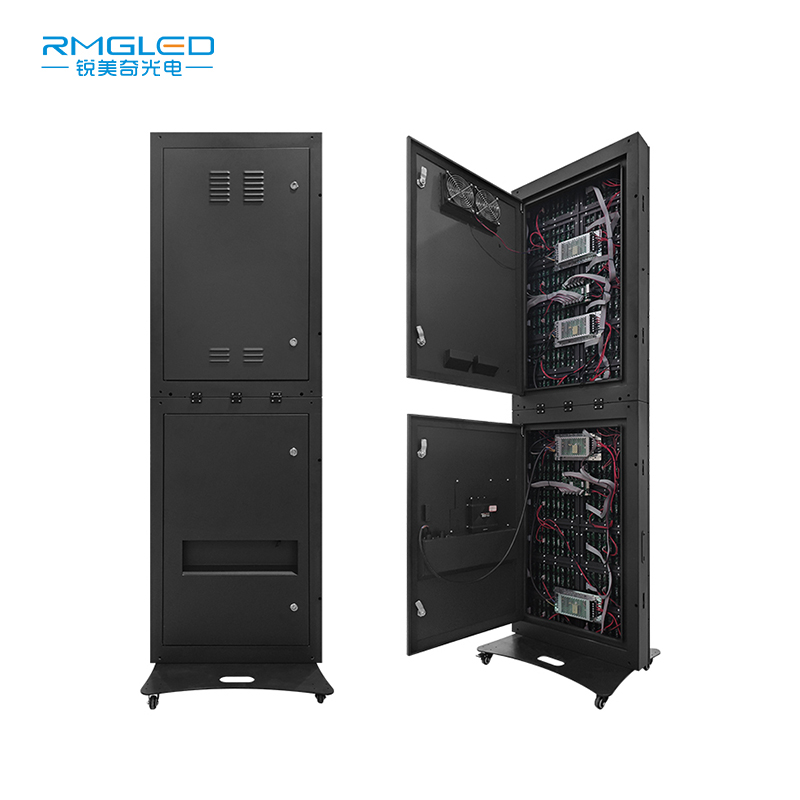
The die-cast aluminum cabinet — the enclosure that houses the LED modules, power supplies, receiving cards, and wiring — is the critical component enabling weather resilience. Aluminum dissipates heat approximately three times more effectively than steel per unit mass, which prevents internal temperature buildup that would degrade LED chips and power supply electrolytic capacitors. The cabinet's internal design typically incorporates a pressure-balancing Gore-Tex vent that allows air pressure equalization between the interior and exterior, preventing seal deformation at altitude or with temperature changes, while blocking liquid water entry.
In cold climates, the relevant specification is cold-start capability — the minimum temperature at which the display can power on and reach full brightness without preheating. Professional outdoor LED screens specify cold-start capability at -20°C to -30°C, achieved through industrial-grade power supplies with wide-temperature electrolytic capacitors and LED driver ICs with extended junction temperature ratings of -40°C to +85°C, per AEC-Q100 automotive-grade qualification. In hot climates, the limiting factor is thermal management: a 100-square-meter display operating at full brightness in 45°C ambient temperature generates approximately 4-6 kilowatts of waste heat that must be dissipated passively through the cabinet's aluminum structure or actively through integrated fans in sealed, filtered airflow paths.
The Economics of Content Flexibility
Beyond the physical performance advantages, the economic case for outdoor LED screens in advertising projects rests on content flexibility. A printed billboard campaign requires new artwork, printing, shipping, and physical installation every time the creative changes — a process that costs $500-2,000 per billboard face and takes 7-14 days. A digital outdoor LED screen changes content in under 30 seconds via remote content management over 4G/5G or Wi-Fi. A single screen can display 8-24 different advertisements per day, rotating on timed schedules aligned with traffic patterns — commuter-focused ads during morning rush hours, lunch-oriented content at midday, entertainment promotions in the evening.
Programmatic digital-out-of-home advertising platforms further enhance the economic efficiency: advertisers bid for display time slots via real-time auctions, and the screen operator captures revenue from multiple advertisers per day on a single panel rather than leasing the entire face to one advertiser for a 4-week minimum. Industry data from the Out of Home Advertising Association of America indicates that digital billboards generate 4-7 times the revenue per face compared to static billboards, which explains the ongoing conversion of printed billboard inventory to digital outdoor LED screen installations across major highway corridors.
Procurement Guidance
For outdoor advertising projects evaluating outdoor LED screens, the technical specification checklist should include: minimum 6,500 nits calibrated brightness — not theoretical maximum but calibrated, post-calibration uniformity-adjusted brightness; IP65 front and IP54 rear protection ratings as minimum; die-cast aluminum cabinet construction with corrosion-resistant coating; refresh rate of at least 3,840Hz to eliminate on-camera scan lines; and grey scale processing of at least 14 bits (16,384 levels) to maintain smooth gradients in low-brightness content. The pixel pitch selection follows the minimum viewing distance rule: pixel pitch in millimeters equals the minimum viewing distance in meters for perceptually seamless images. A P10 outdoor LED screen appears seamless at 10 meters or more — suitable for highway billboards viewed from 30-100 meters. A P4 or P5 is necessary for urban street-level installations viewed from 4-10 meters.
Frequently Asked Questions
What brightness does an outdoor LED screen need for direct sunlight visibility?
A minimum of 5,000 nits calibrated brightness is required to maintain readable contrast under direct sunlight. For installations facing south in equatorial or desert climates, 8,000-10,000 nits provides comfortable viewing margin. Brightness below 4,000 nits results in washed-out images where text becomes illegible and brand colors appear desaturated under 100,000 lux ambient illumination.
How long can an outdoor LED screen operate before needing major component replacement?
LED modules typically maintain at least 80% of initial brightness at 50,000-60,000 hours of operation. Power supplies rated for outdoor use have a typical service life of 50,000-100,000 hours depending on ambient temperature. At 16 hours daily operation, 50,000 hours equals approximately 8.5 years. The die-cast aluminum cabinet structure can last 15-20 years with proper maintenance.
What is the difference between IP65 and IP67 for outdoor LED screens?
IP65 protects against water jets from any direction at 12.5 liters per minute through a 6.3mm nozzle. IP67 protects against immersion in 1 meter of water for 30 minutes. For most outdoor LED screen installations — highway gantries, building facades, stadium exteriors — IP65 front protection is sufficient. IP67 is recommended for installations in coastal or flood-prone areas.
Can outdoor LED screens operate in extreme cold below -20°C?
Professional outdoor LED screens with industrial-grade power supplies and AEC-Q100 qualified driver ICs can cold-start at -20°C to -30°C without preheating. Below -30°C, integrated cabinet heaters may be specified. The LED chips themselves operate efficiently in cold temperatures — the limitation is the power supply electrolytic capacitors, which lose capacitance at low temperatures.
How does pixel pitch affect the cost of an outdoor LED screen?
Pixel pitch is the single largest cost driver — a P4 outdoor LED screen contains 62,500 pixels per square meter versus 10,000 pixels per square meter for a P10. The P4 screen costs approximately 2.5-3.5 times more per square meter because it uses 6.25 times more LED chips and requires tighter manufacturing tolerances for module alignment. Select the largest pitch that satisfies the minimum viewing distance.
What remote control options are available for outdoor LED advertising screens?
Professional outdoor LED screens support 4G/5G, Wi-Fi, and Ethernet connectivity for remote content management. Cloud-based control platforms enable scheduling of ad rotations by time of day, day of week, and audience demographics. GPS synchronization allows multiple screens across a city to display coordinated content sequences. Emergency alert override capability is mandatory for installations near highways in most jurisdictions.
