 EN
EN

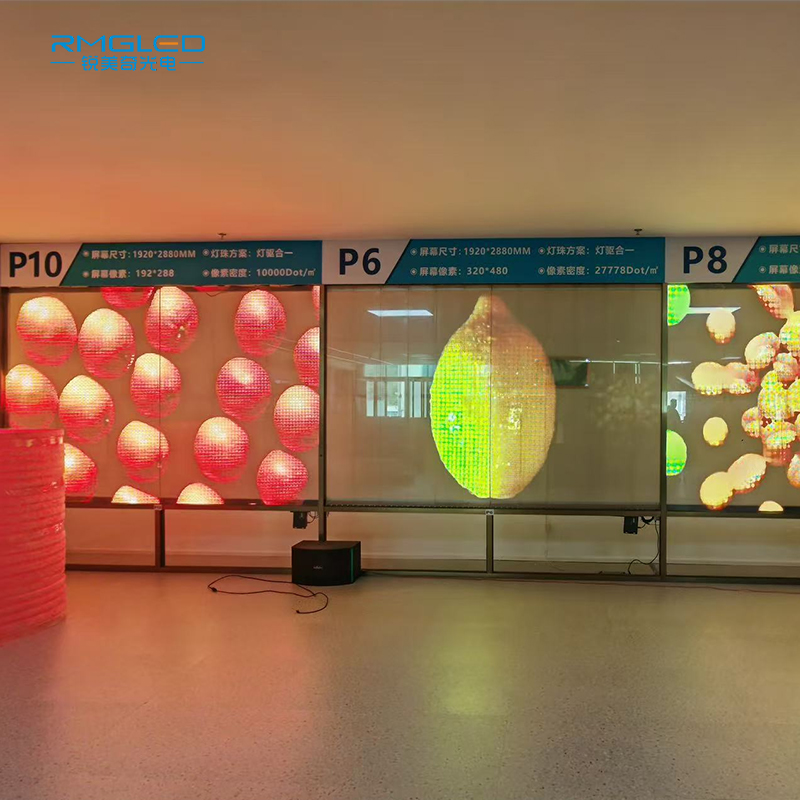
Core Working Principle of Transparent LED Screens
A transparent light-emitting diode screen operates on a fundamentally different structural principle than conventional digital walls. Instead of a dense, opaque panel, it uses a grid-based pixel architecture where diodes are mounted on narrow strips or a fine mesh, creating intentional gaps that occupy 50 to 90 percent of the module surface. These open areas allow ambient light and exterior views to pass through unimpeded, which is a deliberate design choice rooted in the fence effect where the human visual system perceives the illuminated image as a coherent overlay rather than a fragmented pattern. Maintaining a minimum pixel density, typically between 3.9 and 10 millimeters in pitch, is essential for perceptual integration because viewers resolve individual pixels and lose image continuity below this threshold. Side-emitting diodes further enhance transparency by directing light forward instead of backward, transforming the display into a bright, semi-transparent film that coexists with the space behind it.
Visual integrity hinges on precise optical path management, which involves the coordinated control of emitted light, transmitted ambient light, and viewer perception. High refresh rates often exceeding 3840 hertz ensure flicker-free, stable illumination that appears to float on the glass surface. The absence of a traditional back panel eliminates internal reflections, while shallow module depth minimizes visual obstruction. Crucially, optical design must reconcile screen luminance with ambient light passing through its gaps, and without dynamic compensation, high background brightness can wash out content. To preserve clarity in sunlit environments, driving systems adjust diode output across a range of 2000 to 5500 nits, scaling brightness in real time based on ambient conditions to deliver seamless augmented reality without compromising the view.
Key Performance Trade-Offs in Transparent LED Screen Design
Designing a transparent display requires balancing competing factors that directly affect both visual performance and architectural transparency. Brightness and transparency share an inherent inverse relationship: more open area increases transparency but reduces active light-emitting surface, limiting peak luminance. Current commercial models span 2000 to 5500 nits at transparency levels of 60 to 95 percent. A 60 percent transparent screen built with tighter pixel spacing can achieve 5000 to 5500 nits to ensure visibility in direct sunlight, whereas a 95 percent transparency panel constrains typical brightness to 2000 to 2500 nits. For example, a 3.4-millimeter pitch panel with 60 percent transparency delivers 4000 to 4500 nits, while a 10-millimeter pitch achieving 95 percent transparency rarely exceeds 2500 nits. Designers therefore prioritize either high luminance for daylight legibility or maximum openness for architectural integration, with most retail installations settling at 70 to 80 percent transparency.
Pixel pitch, which is the center-to-center distance between adjacent diodes, directly governs resolution and transparency. Smaller pitches increase pixel density and sharpness but reduce open area, and transparent screens typically use pitches from 3.9 to 10 millimeters. A 3.9-millimeter pitch offers roughly 65 percent transparency and 65000 pixels per square meter, making it ideal for detailed content viewed from 2 to 3 meters in retail windows. A 10-millimeter pitch achieves up to 95 percent transparency and 10000 pixels per square meter, making it appropriate only for large-scale facades viewed from 10 meters or more. Advances like chip-on-board packaging reduce each pixel's opaque footprint, enabling a 5-millimeter pitch to reach 80 percent transparency—a level previously attainable only with larger pitches.
| Application | Optimal Transparency | Primary Consideration | Typical Brightness |
| Retail Window Display | 50 to 70 percent | Product visibility behind the screen paired with vivid advertising | 3000 to 4500 nits |
| Stage Backdrop | 30 to 60 percent | Dynamic concert visuals, partial see-through adds depth and lighting effects | 2500 to 4000 nits |
| Architectural Glass Facade | 80 to 95 percent | Preserving daylight and outward views, subtle corporate branding | 2000 to 3000 nits |
| Museum Exhibition | 70 to 85 percent | Augmenting exhibits without obscuring artifacts, high color accuracy | 2000 to 3000 nits |
Material and Structural Innovations Enhancing Dual Performance
Advances in materials and structural design are critical to reconciling the competing demands of display quality and transparency. Shrinking the physical footprint of light-emitting elements is the most direct route to higher transparency, as traditional surface-mounted packages occupy 2 to 3 square millimeters of opaque area per pixel, whereas emerging chip-on-board and micro-diode formats reduce this to as little as 0.5 square millimeters. This allows a 5-millimeter pitch display to achieve over 90 percent transparency, up from roughly 70 percent with conventional packaging. Because the opaque area shrinks without increasing pixel spacing, finer pitches down to 3.9 millimeters now deliver higher resolution while maintaining strong transparency, supporting vivid and legible content in retail windows and architectural glass without visual clutter.
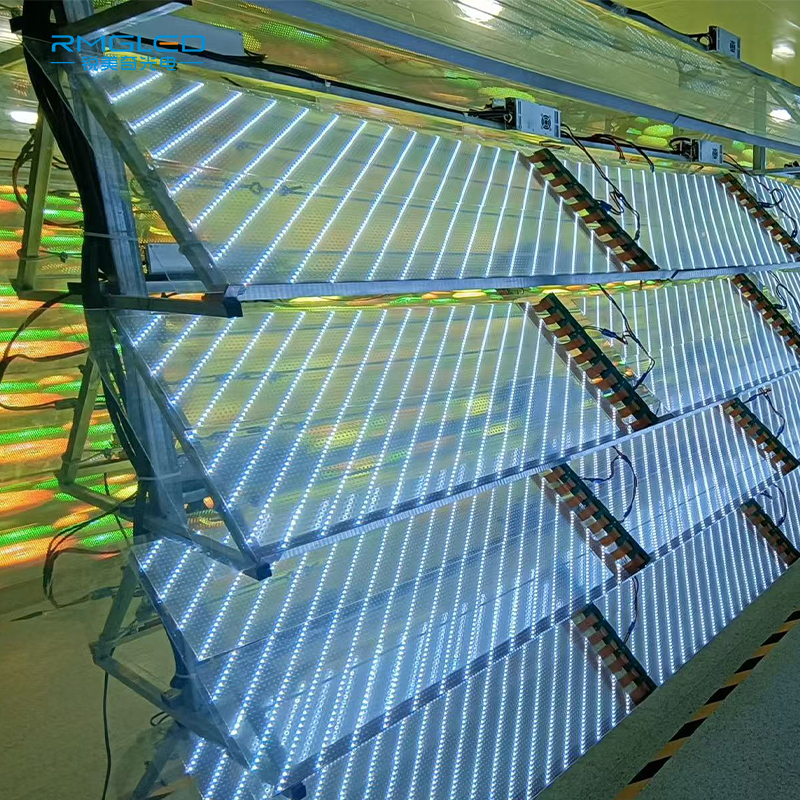
Even with minimal opaque diodes, the supporting substrate can degrade visual quality because standard glass reflects approximately 4 percent of incident light, creating glare that washes out images in bright environments. Transparent conductive oxides like indium tin oxide provide electrical pathways without adding significant opacity, but their reflectivity must be mitigated. Nano-structured anti-reflective coatings reduce surface reflectance to below 0.5 percent, virtually eliminating ghost images and boosting perceived contrast by up to 30 percent under direct sunlight. When paired with low-iron glass substrates that maximize visible light transmission, these innovations ensure vivid content in daylight-flooded atriums or storefronts, integrating the display seamlessly into the architecture. According to a 2023 installation survey by the International Digital Signage Association, retail window displays achieved highest engagement at 60 percent transparency, while architectural facades averaged 85 percent transparency to minimize visual obstruction.
Frequently Asked Questions
-
What is a transparent light-emitting diode screen?
A transparent light-emitting diode screen is a display technology that integrates diodes into a grid-based structure, allowing light and visibility to pass through while simultaneously displaying digital content.
-
What are the benefits of using a transparent display?
Transparent displays offer several benefits, including aesthetic integration into glass architectures, augmented reality effects, and the ability to balance digital content visibility with physical transparency.
-
What factors affect the brightness and transparency of these screens?
Brightness and transparency are inversely related because higher transparency reduces the light-emitting surface, which decreases maximum brightness. Pixel pitch, diode type, and material choices also influence these factors.
-
Which applications commonly use transparent screens?
Common applications include retail window displays, architectural facades, stage backdrops for live events, and museum exhibitions, each requiring different levels of transparency and brightness.
-
What advancements have improved the performance of transparent displays?
Technological advancements like micro-diodes, chip-on-board packaging, transparent conductive oxides, and anti-reflective coatings have significantly enhanced both transparency and image quality.
